Access
Can you download the artifact? Can you run it on your own machine? Can you study its parts? An open door is the first dimension of openness — and not the only one.
A forthcoming book
A question for the age of open source and artificial intelligence.
A model can be downloaded without its training data. Source can be visible without the freedom to use it. What, exactly, does the word open promise?
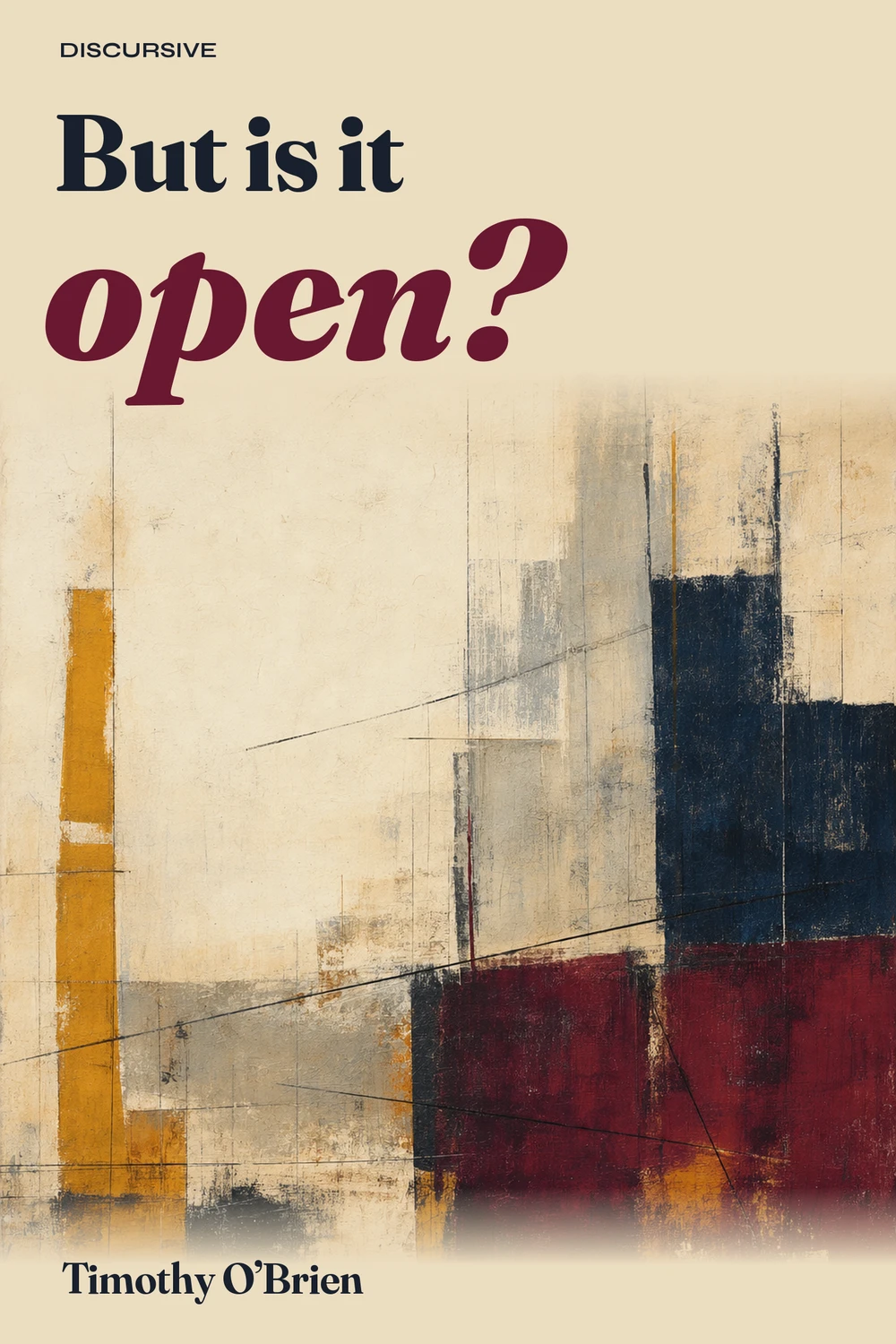 But Is It Open? · Timothy O’Brien
The question
Open source has a meaningful definition. But openness itself takes many forms.
A release can make its code visible but restrict how you use it. A model can share its weights but not the information needed to reproduce it. These differences aren’t footnotes; they change what people can actually do.
But Is It Open? follows the people, licenses and institutions behind the word—and asks how to talk about it more precisely.
A closer look
Start with the thing in front of you. Then ask what you can do with it—and who gets a say.
Can you download the artifact? Can you run it on your own machine? Can you study its parts? An open door is the first dimension of openness — and not the only one.
What does the license permit? Use, study, modification, redistribution, commercial deployment. Each permission is a separate question; the restrictions that travel with the artifact are part of the bargain.
Who decides what changes? Can you participate in the project? Can the terms be altered unilaterally? Openness includes a question about who holds the keys — and whether the permission can survive a change of mind.
The licenses we know are still useful. The things we’re calling open have changed.
Inside the book
Six parts trace the history, people, economics and legal questions behind open source and AI.
A proposed table of contents. Titles and structure may change.
A Question Asked by a Participant
But Is It Open? · A Short History of Open-Source Licensing · What Open Source Means
Who Is Behind Open Source? · The Open-Source Ecosystem in Numbers · Foundations and the Open Method · Beyond Code · Who Pays for Openness? · The Microsoft Turn
The Books That Predicted the Future · The Contribution Bottleneck · The Security Question · Building Collective Defenses
The Model Is More Than the Weights · Open Weights Are Not the Whole Story · A Field Guide to Open-Claiming Models · The Terms That Travel with the Weights · What Happens When the Guardrails Come Off?
Legal Background for Engineers and Users · Legal Background for Lawyers · Cross-Jurisdiction Model Use
The Openness Profile · What Should Come Next?
Ask Before You Download
From the blog
Openness is a shape, not a number: accessible but weakly reproducible, transparent today, relicenseable tomorrow.
Read the essay 1 minute read